
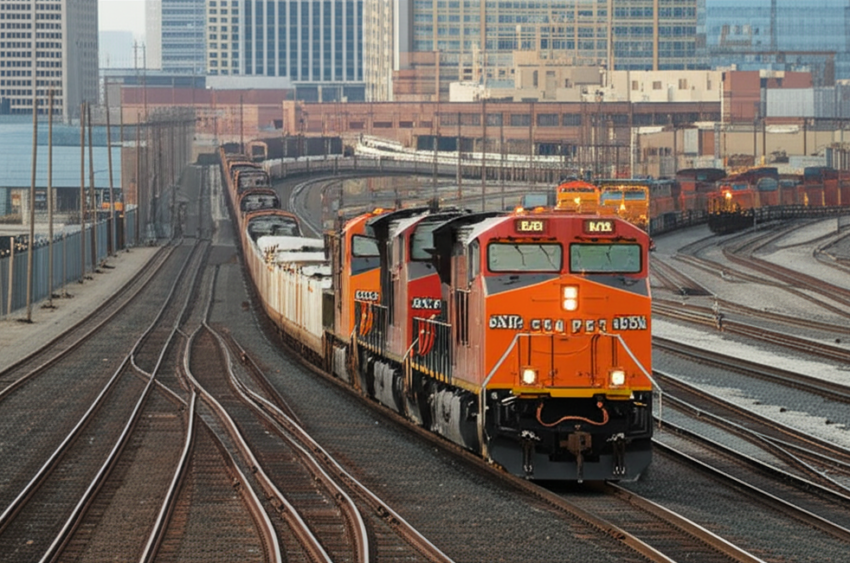
Union Pacific’s Plan to Add Trains in Chicago Raises Alarms 🚂⚠️
Chicago, known affectionately and somewhat ominously as the railroad crossroads of America, may soon experience a transformation that feels less like progress and more like a steel serpent tightening around the city’s throbbing heart. Union Pacific’s recent announcement to increase freight train traffic through the metropolitan area promises expansion—but many are wondering if the city’s arteries can handle another pulse of iron and noise. Will more trains ultimately move America’s cargo faster, or just choke downtown dreams with endless waits and fraying nerves?
The City as a Battleground: Rail Expansion vs. Urban Life
In a landscape where trains slice through neighborhoods like impatient stalks of bamboo, Union Pacific’s plan to add dozens of additional daily freight trains doesn’t simply invite logistical headaches—it thrills some executives while sending shudders through residents, commuters, and civic planners alike. The irony unfolds almost by design: Chicago, celebrated as North America’s central pivot for railroads, is simultaneously one of the nation’s most congested rail hubs, where holding patterns for trains stretch longer than a Midwestern winter night.
This stark antithesis — the city that built an empire on railroads now strangles in its tracks — reveals a broader dilemma. Chicago’s rails are a bit like an old river once wild and thriving, now dammed and stilled by relentless industrial demands. The tangled web of Union Pacific, BNSF, and Norfolk Southern railroads overwhelm the city’s infrastructure, juxtaposing economic vitality against commuter frustration and environmental strain.
A Symptom of Demand, a Source of Discord
But why add trains now—amid deadlock and public outcry? The answer, as always, is buried in the relentless appetite of supply chains. Union Pacific touts this strategy as a response to booming freight volumes post-pandemic, aiming to hasten contact between producers, consumers, and ports across the continent.
Yet, the plan resembles trying to quench a fire by pouring gasoline into a fireplace clogged with logs — a strikingly ironic attempt to speed commerce by deepening the bottleneck. Neighborhoods along the route, from Cicero to Englewood, report drastic increases in blockages, multiplied idling times for emergency vehicles, and skyrocketing noise pollution. These trains, like giant metallic waves, crash intermittently through human lives—sleep interrupted, children’s play paused, local economies disrupted.
Safety Concerns and the Shadow of Past Disasters
Should we forget that the railroad is not just an economic engine but a high-stakes ballet of engineering risks? The spectacular derailments of the past, emblazoned in public memory, lend a chilling counterpoint to Union Pacific’s optimistic projections. Increased train traffic through urban corridors invariably raises the stakes for both accidents and security.
Local officials stress that more trains mean more crossings and prolonged gate closures, which doubles as an invitation to tempt fate—drivers taking risks, cyclists weaving impatiently, and pedestrians squeezed between deadlines and barriers.
Union Pacific counters by pointing to modern signaling technology and investments in safety programs, but critics ask: are incremental upgrades enough in a city where tracks intersect thousands of residential blocks? The danger lurks in the margins between technology and human behavior, a murky gap growing wider as trains multiply.
Environmental Echoes: More Diesel, More Dust
If Chicago were a kaleidoscope, the addition of more trains paints a rather bleak new pattern for the urban environment. Each additional diesel-powered locomotive is a plume of particulates and nitrogen oxides released into an atmosphere already burdened by industrial smog. The city, whose struggle with air quality is no secret, may witness an exacerbation of respiratory ailments precisely where train corridors thread through densely populated neighborhoods.
Logistics vs. Livability: The Tug-of-War
The tension mounts as planners, businesses, and community advocates wrestle over Chicago’s rail future. Railroads argue that efficient freight movement supports jobs and economic resilience—for the city and the region. Without robust freight capacity, supply chains falter, prices rise, and markets struggle. But residents — many of whom live near rail corridors by necessity rather than choice — see daily life sinking beneath steel barriers, unruly horn blasts, and endless waits at intersections.
There’s an unmistakable irony layered here: the mighty titan of American steel rails, built to unite a nation, now divides the very communities it ought to serve.
Could Innovation Chart a Middle Path?
What if the solution lies not in more trains, but smarter trains? Some urban transport experts envision dedicated freight corridors bypassing congested zones, advanced scheduling algorithms that smooth traffic flow, and increased electrification of locomotives to dial down pollution. Yet these alternatives require political courage and massive investments, with no overnight relief for Chicago’s snarled streets.
One might pause here—imagine the Chicago rail network as a sprawling ant colony, where each freight ant carries critical loads but too many ants on the main trail result in traffic jams that doom the colony’s efficiency. The challenge is to choreograph those ants differently or reroute the trail, not just add more ants and wonder why the system jams.
What Happens When Progress Stalls at the Crossing?
At its heart, the debate over Union Pacific’s plan is a microcosm of a bigger riddle. How does a city reconcile its historic role as America’s freight nexus with present-day demands for livability, safety, and environmental sustainability?
Chicagoans know well that trains are both a blessing and a burden, a powerful analytical antithesis between economic lifeblood and daily frustration. As steel meets street, it’s clear that adding more trains without addressing the underlying congestion and community impacts risks turning a signal of prosperity into a blaring warning light. It makes one wonder if our faith in unending growth sometimes blinds us to the fact that not all expansions are progress—and that, sometimes, waiting for a train isn’t just about patience but survival itself. 🚦